V/05 · BUILD LOG

What we built, and what it measured.

This is the development record, in order. Nothing here is a plan: every entry is something that was cut, wired, written, or flown, and the number it produced when we checked it.

9ENTRIES LOGGED
4FLIGHT & TEST
9WITH PHOTOGRAPHY
42GCS TESTS PASSING
  1. 09

    SOFTWARE

    The team runs on a mission board we wrote

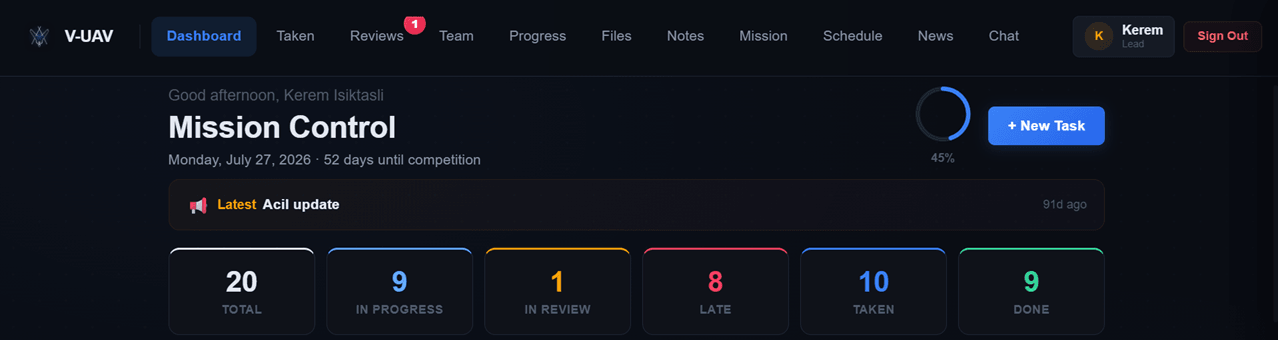
    Nine people across four stations do not stay in step by memory. The team runs on its own web board: every task carries an owner, a station and a deadline, work moves through review before it counts as done, and the dashboard shows where the whole campaign stands against the competition date. Files, notes, schedule and announcements live in the same place.

    Tasks under tracking
    20
    Per task
    Owner, station, deadline, review state
    Sections
    Dashboard, reviews, progress, files, schedule
    Built by
    The team, in house
    The team mission board: navigation across dashboard, reviews, team, progress, files, notes, schedule and chat, a completion ring, the days remaining until the competition, and counters for total, in-progress, in-review, late, taken and done tasks
    THE BOARD THE CAMPAIGN RUNS ON · EVERY TASK OWNED, DATED, AND REVIEWED BEFORE IT COUNTS
  2. 08

    FLIGHT

    Autonomous waypoint mission flown end to end

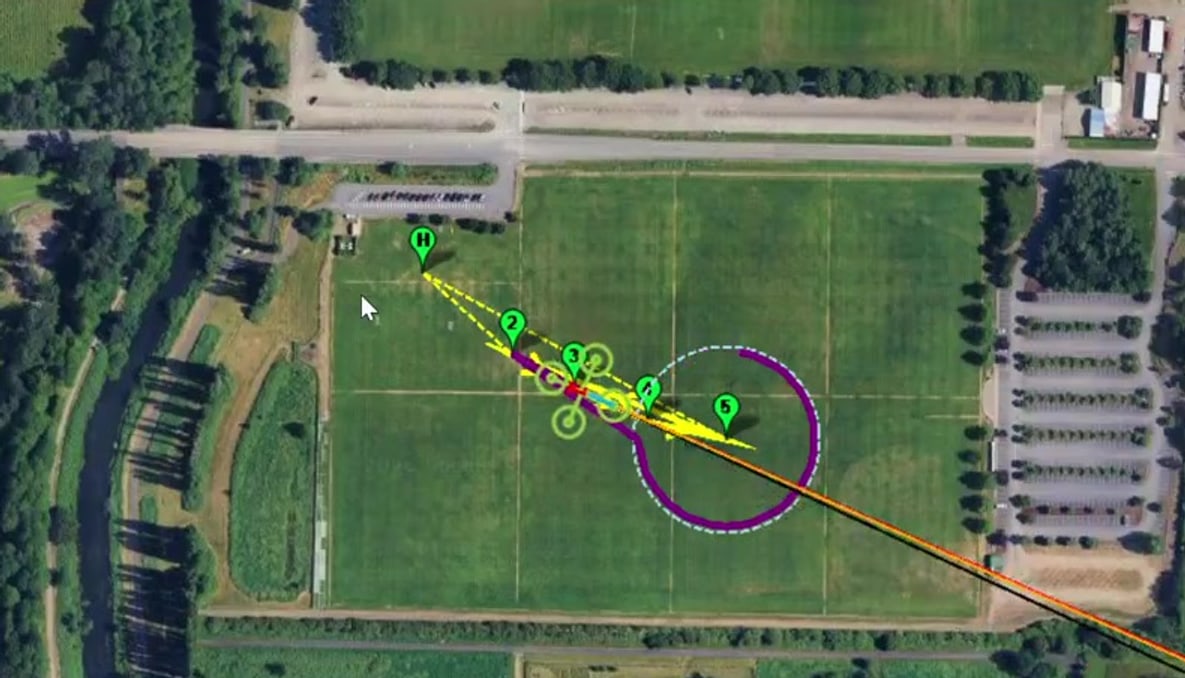
    The aircraft flew a full waypoint mission under autonomous control, monitored from the ground station. The screen recording of that session runs on the systems page: the flight plan, the aircraft tracking it, and the telemetry as it happened.

    Mode
    AUTO, full mission
    Altitude flown
    25 to 57 m AGL
    Cruise ground speed
    ≈ 7.5 m/s
    Operator action
    Monitoring only
    Ground station map during the autonomous flight: the numbered waypoint route, the aircraft tracking it, and the loiter circle at the far end
    THE ROUTE, AND THE AIRCRAFT FLYING IT · NOBODY ON THE STICKS
  3. 07

    SOFTWARE

    Ground control station built in house

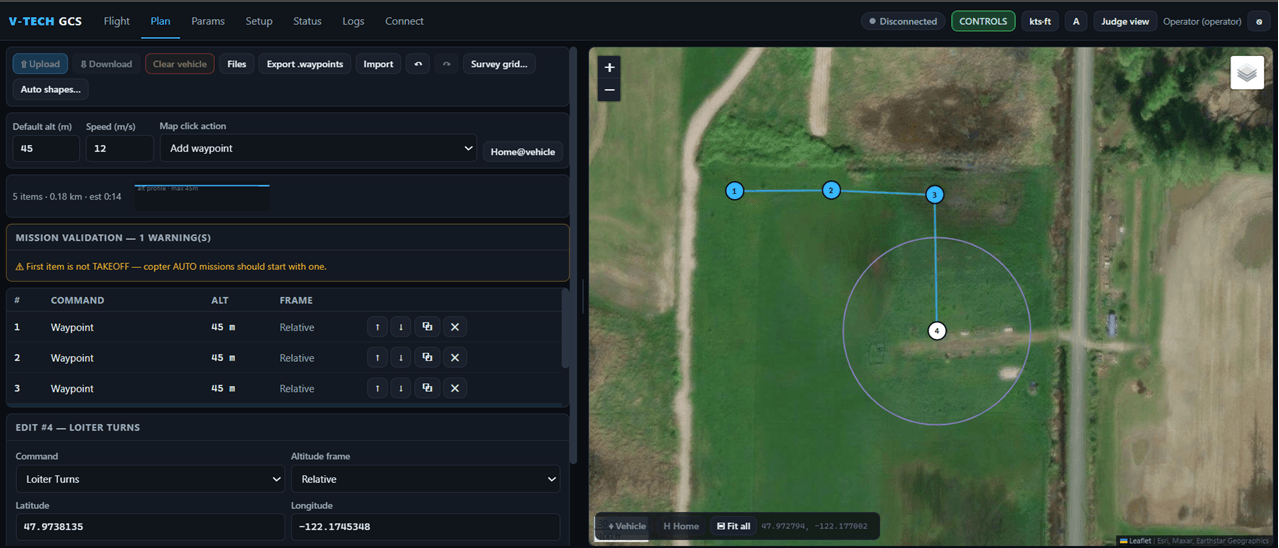
    Rather than fly stock software, the team wrote its own web ground station: flight instruments, a live map, mission planning with a survey-grid calculator, parameter editing, and the judge display required at the competition. It runs in any browser against the aircraft link.

    Automated tests
    42 passing
    Verified against
    Simulation before flight
    Judge display
    Map, ground speed, AGL altitude
    Mission validation
    Warns before a bad plan is uploaded
    Dependency on internet
    None for flight-critical paths
    The V-TECH ground station on its Plan tab: a four-waypoint mission with a loiter turn being edited, the waypoint table with altitudes and frames, a mission-validation panel warning that the plan does not begin with a takeoff, and the route drawn on the satellite map
    OUR OWN STATION, PLANNING A MISSION · IT CHECKS THE PLAN AND SAYS WHAT IS WRONG BEFORE IT EVER REACHES THE AIRCRAFT
  4. 06

    TEST

    Link loss and failsafe rehearsed before flying

    Failsafe behaviour was exercised in simulation and on the bench before it was ever needed in the air: what the aircraft does when a telemetry link drops, when the operator hands over, and when it is told to return. Remote ID broadcast was confirmed independently on a phone.

    Telemetry links
    Two independent, plus manual RC
    Link-loss response
    Hold, reconnect, then return to launch
    Remote ID
    Broadcast confirmed on a handset
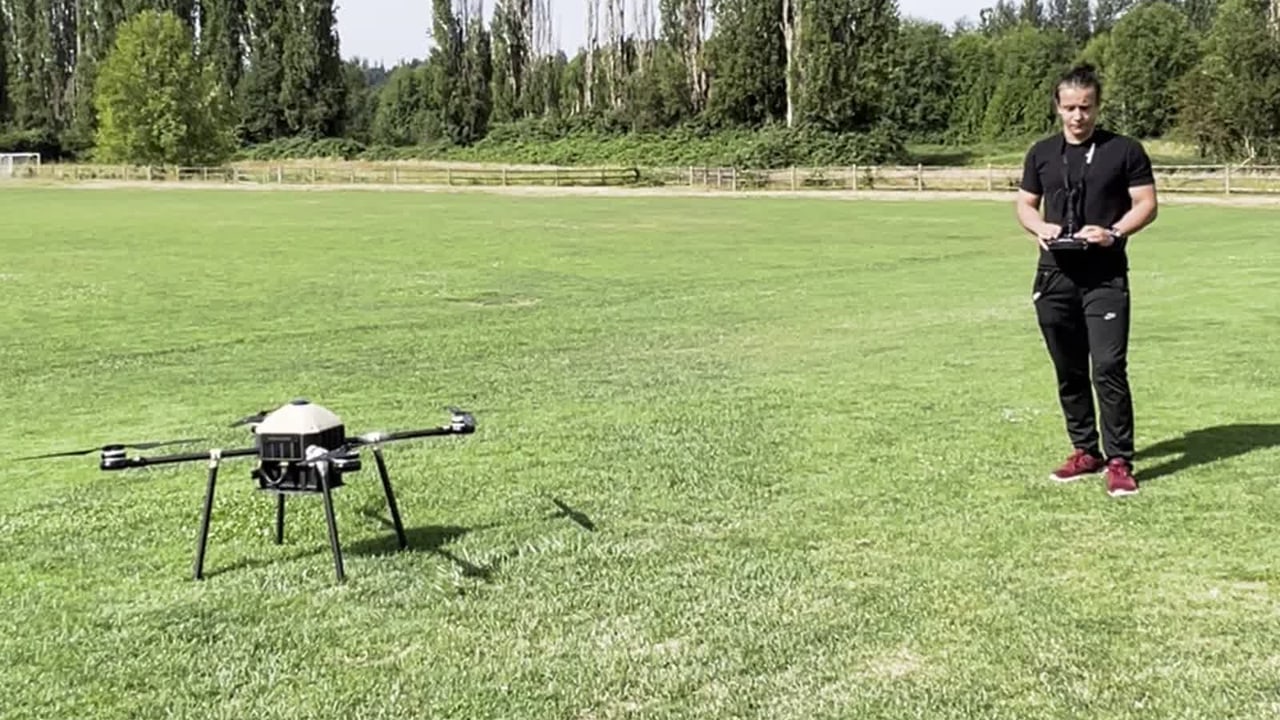
    The aircraft airborne over the field with the safety pilot standing below, transmitter in hand, ready to take control
    THE WHOLE POINT OF THE REHEARSAL · SOMEBODY IS ALWAYS HOLDING THE OTHER RADIO
  5. 05

    TEST

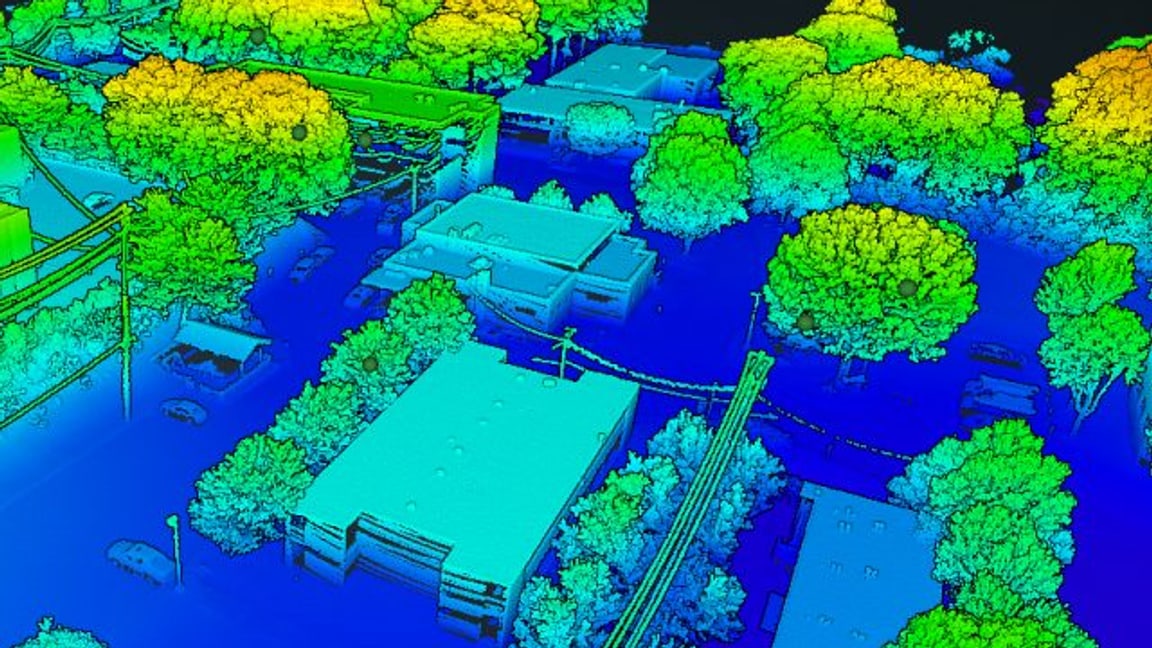
    Imagery run turned into a full field map

    A survey run was flown and the imagery put through the mapping pipeline on the ground. The output resolves buildings, trees, roads and vehicles by height — enough to plan against, and the same product the detection stack reads targets out of.

    Input
    Nadir imagery from one survey run
    Overlap flown
    80 / 80
    Output
    Height-coloured 3D survey map
    Processing
    On the ground, after the flight
    Close detail of the survey map: individual buildings, parked vehicles, power lines and tree canopy resolved and coloured by height
    CLOSE ON THE OUTPUT · BUILDINGS, VEHICLES AND WIRES, ALL RESOLVED
  6. 04

    FLIGHT

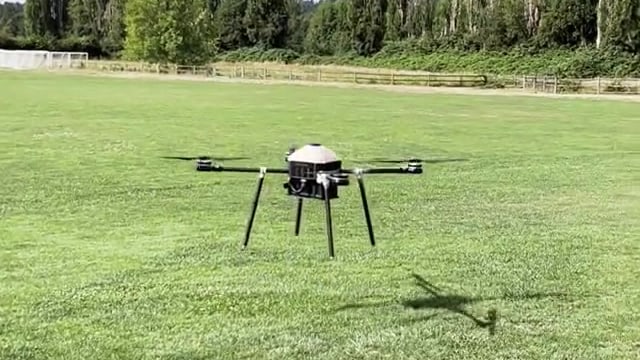
    First hover, then handling checks

    The first time it left the ground was deliberately boring: a low hover with the safety pilot on the sticks, checking trim, vibration and control response before anything autonomous was armed. Everything after this point was built on that baseline.

    Pilot
    Safety pilot, manual throughout
    Checks
    Trim, vibration, control response
    Autonomy
    Not armed until manual flight was clean
    The quadcopter holding a low hover a metre above the grass, its shadow directly beneath it
    A METRE UP, AND DELIBERATELY BORING
  7. 03

    BUILD

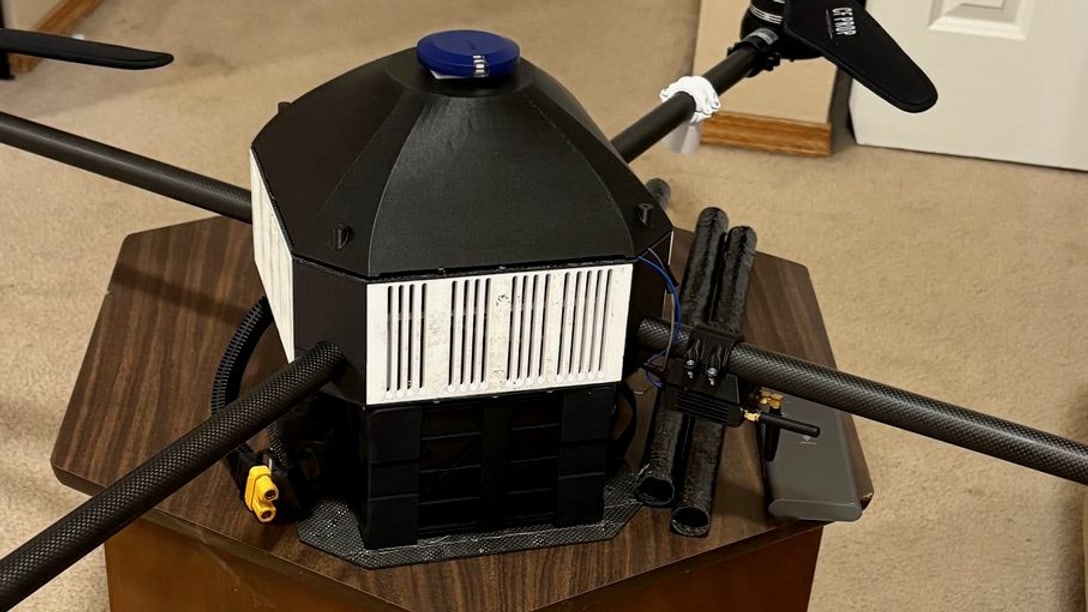
    Carbon airframe assembled, tool-less arms proven

    The X-frame was assembled from carbon-fiber plate and tube. The arms clamp between the plates on knurled thumb screws, so the aircraft breaks down for transport and goes back together at the field without a single tool. Fasteners are sorted, thread-locked and torqued as a standing practice.

    Configuration
    X-frame quad, VTOL
    Assembly
    Tool-less thumb screws
    Transport
    Packs into one case
    Payload bays
    Two, independent
    Close on the centre body: the printed dome over the avionics stack, the antenna masts, and the carbon arms clamped between the plates
    THE CENTRE BODY · WHERE THE FOUR ARMS CLAMP IN
  8. 02

    BUILD

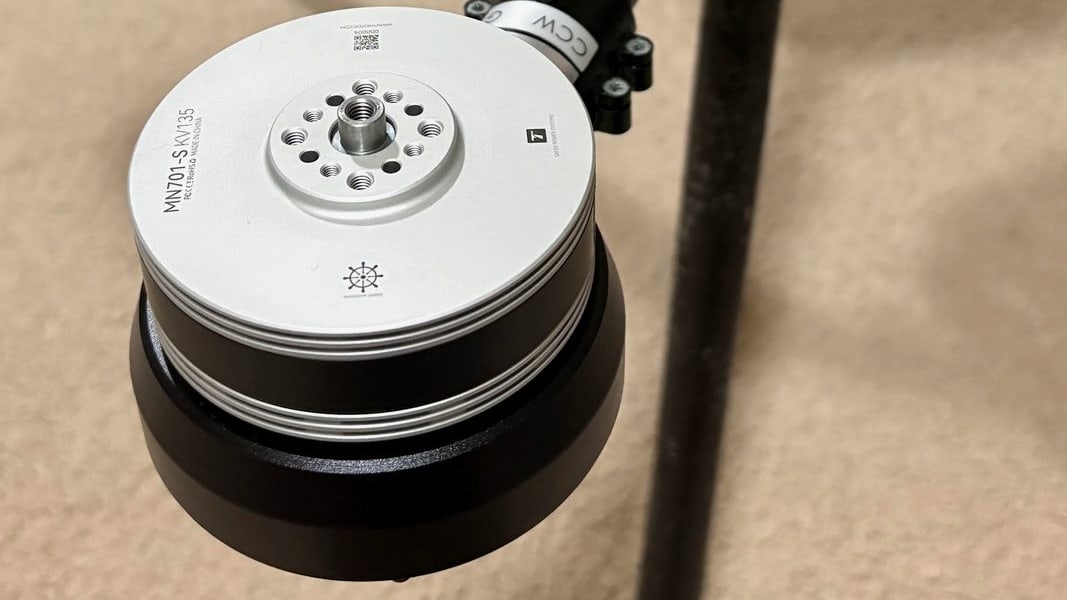
    Propulsion units mounted and bench run

    Each propulsion unit was mounted to its carbon arm and run on the bench before the aircraft ever left the ground, checking rotation, vibration and mounting torque one arm at a time. Rotation direction is marked on the arm clamp itself, so a unit cannot go back on the wrong way.

    Motor
    MN701-S, KV135
    Units
    Four, one per arm
    Checked per unit
    Rotation, vibration, mount torque
    Run
    On the bench, before first flight
    Close on a motor mounted to its carbon arm, the model number MN701-S KV135 stamped on the bell and the CCW rotation ring on the clamp
    ONE UNIT, ONE ARM · ROTATION MARKED ON THE CLAMP
  9. 01

    SAFETY

    Field safety kit standardised

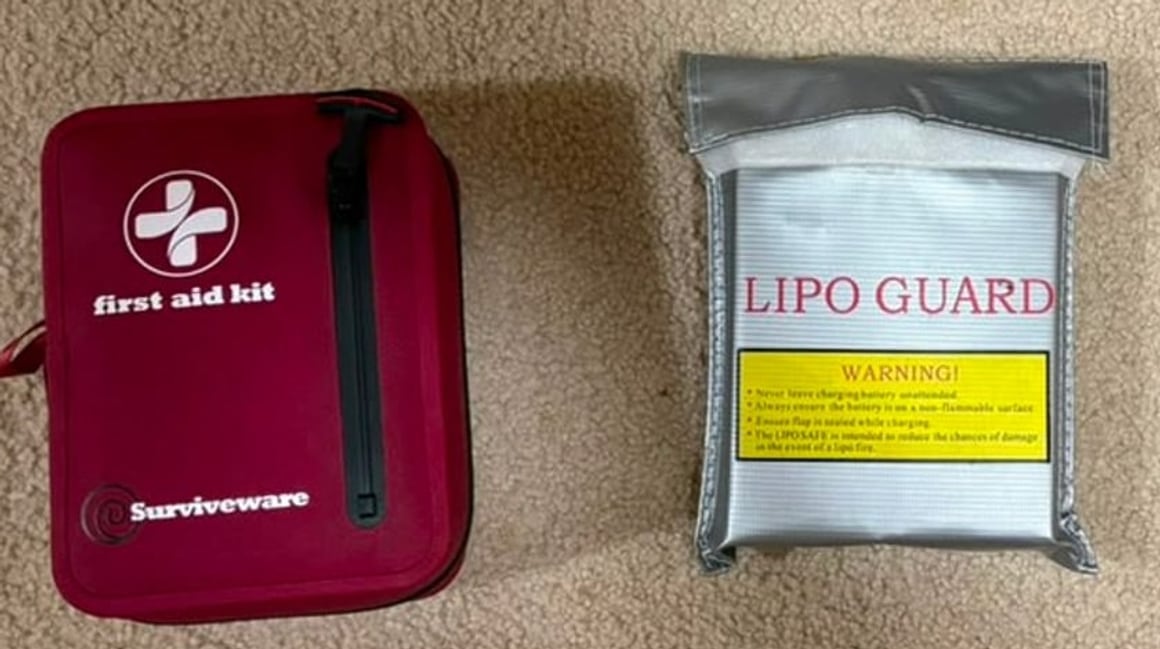
    Every field session now carries the same kit: a fire extinguisher, a LiPo guard bag for charging and transport, and a first aid kit. The preflight checklist on the safety page is the card the team actually works through before each flight.

    The LiPo guard charging bag and the first aid kit from the field safety kit, laid out
    BATTERIES CHARGE AND TRAVEL IN THE BAG · NEVER LOOSE, NEVER UNATTENDED

Still running

The log is not finished.

Every field session adds to it. If you want the technical detail behind an entry — the parameters, the failure we found, the change we made — ask us and we will send it.